Blog
Saturday, July 20, 2019 - 07:00

Lesbian Historic Motif Podcast - Episode 115 (previously 36c) - Book Appreciation with K.J. Charles
(Originally aired 2019/07/20 - listen here)
Transcript pending.
Show Notes
In the Book Appreciation segments, our featured authors (or your host) will talk about one or more favorite books with queer female characters in a historic setting.
- Books mentioned
Links to the Lesbian Historic Motif Project Online
- Website: http://alpennia.com/lhmp
- Blog: http://alpennia.com/blog
- RSS: http://alpennia.com/blog/feed/
- Twitter: @LesbianMotif
- Discord: Contact Heather for an invitation to the Alpennia/LHMP Discord server
- The Lesbian Historic Motif Project Patreon
Links to Heather Online
- Website: http://alpennia.com
- Email: Heather Rose Jones
- Twitter: @heatherosejones
- Facebook: Heather Rose Jones (author page)
Links to KJ Charles Online
- Website: kjcharleswroter.com
- Twitter: @kj_charles
- Facebook: KJ Charles Chat (group)
Major category:
LHMP View comments (0)
Thursday, July 18, 2019 - 07:53
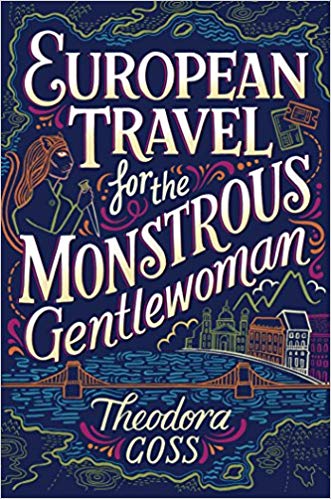
I am frustrated in my desire to love this series. I love the concept (all the sff/fantasy/gothic novels of the 19th century were true in the same universe) and I love the characters (the daughters or female creations of the men in all those novels come together in a found family and have adventures). But this is the second book in the series in which I found the plot thin and the narrative style ponderous and somewhat bloated. The characters do a lot of traveling around across Europe and having episodic encounters with the antagonists, but I found it hard to get a sense that there was an overarching storyline. And (without spoilers) I felt that Our Heroines didn't really do much in the final climax other than show up.
Goss has a fractally detailed familiarity with the literature she draws on, and with the historic and geographic settings she uses, but those details were included in the narrative at about two levels above what would have worked for me. Rather than sketching out the setting just enough for the reader to get an impression and fill the rest in, we are told in detail exactly how the rooms are furnished and what the characters are eating, and are repetitively told things about their relationships to each other that we already know. This adds to slowing down the narrative sufficiently that I wasn't sure I was going to stick with it to the end. (I did.) Often at this point in a review, I'll say something about how the writing was solid and the story just didn't hit my sweet spot, but in this case the overall concept was totally sticky with my sweet spot, but the writing kept getting in the way of enjoying it as much as I wanted to.
I was also disappointed for a very personal and completely unfair reason. Other readers had promised me that this all-female-protagonist series was getting a bit of same-sex romance in book 2 and I was totally there for it, despite there being no hint of the fact in the promotional copy. But--and I don't consider this a spoiler--the same-sex element was simply the inclusion of Sheridan LeFanu's Carmilla among the literary characters who make up the supporting cast. Carmilla is canonically attracted to women and comes from exactly the sort of literature this series is based on. But I confess I was hoping that maybe we'd get a bit of queer rep among the protagonists. Who are all fascinating and indiidual characters. And who I'd love to read about in a story that had a more engaging structure.
Major category:
ReviewsTuesday, July 16, 2019 - 07:50

There's a chapter where my central characters spend a day exploring the waterways of the city: the Rotein River itself, the new industrial transport channels, and the old chanulezes, which had their origins in domesticating the hydroscape of the city. Some of the chanulezes acted as a second set of roads, some as little more than drainage ditches, and some had long since been bricked over and forgotten...
It is, perhaps, a landscape that wouldn't entirely hold up to strict scrutiny, given the theoretical location of Rotenek. A landscape that requires something of a broad plain and a more fat and lazy river than the Rotein has a right to be. And--quite frankly--Rotenek is getting overdue for a significant urban renewal project that adds some broad avenues for better access, covers over the chanulezes entirely, and steps up the engineering of their flood control measures, as well as perhaps recognizing that shipping would be better moved entirely downriver to Iser. And perhaps much of that will be started in the aftermath of...ah, but that's all in the future and not our concern today.
Our characters have piled into Liv's boat and spent a day getting to better know the chanulezes and each other. And now Roz is reflecting on the experience from a tie-up on the south bank of the Rotein, from which the landscape of her life is spread out in a single view.
* * *
Looking at the Vezenaf from across the river was like layers in a pastry, with the gardens right by the water, then the great houses side by side nearly touching each other, and behind that a row of trees and bare rock slope that climbed up the other side to the upper town. The upper town wasn’t any higher than the tops of the great houses, but it was safe from anything the river might do.
Looking further downriver toward the Pont Vezzen where we’d started, the houses got smaller and even more crowded until you got to the broad street that led from the bridge up to the Plaiz. A public landing stood just above the bridge and the palace dock with stairs zigzagging up to the street, but without the gates and guards of the other one. I hadn’t noticed when we passed it before, but the brick river-wall behind it was built in broad low arches, like a bridge seen sideways. Most of them were filled in, but one just above the end of the landing was darker, like it was open.
Even the parts of the city I knew well were different from a boat. The chanulezes were easy to overlook if you didn’t travel on them all the time. Just a matter of knowing the streets where you had to go the long way to cross a bridge. I only really had to worry about that down near the Nikuleplaiz. But for Celeste it would be just the same as knowing the streets and alleyways.
Major category:
TeasersPublications:
FloodtideMonday, July 15, 2019 - 07:00

Sometimes I have a run of LHMP entries on a particular topic simply by chance, sometimes I'm organizing a large number of items and grouping them by topic is simply a fun way to approach them. At the moment, I've tackled a series of articles and books revolving around cross-dressing themes for two intersecting reasons. Firstly, I'm working on developing my paper on cross-dressing narratives into an article for publication, so it makes sense to become familiar with as much background information as I can. Secondly, with that theme in mind, I picked up a number of publications on this theme at Kalamazoo this year, and I'm trying to prioritize new acquisitions on the blog.
This one marks the end of the current theme, for now. In looking at various cross-dressing/gender-disguise motifs in history, the "transvestite saints" motif stands out as somewhat distinct from other contexts and this article rather hits the nail on the head as to why. The stories mostly normalize the idea that to be female is to be lesser and imperfect. That saintliness is an inherently masculine characteristic. And moreover, that even for saintly women who are trying to leave behind their femaleness, their bodies are necessarily sexualized and disruptive. When de facto same-sex erotic desire intrudes into these tales, it isn't a comedic-tragic story of misdirected romance (as it typically is in chivalric romances and drama) but instead raises themes of predatory, sexually voracious women who then punish "men" with false accusations of seduction and rape when they are spurned. (Now there's a theme we'd all be happy to retire from the stage finally. Alas.)
It's hard to see this genre as empowering women as women to live better, more fulfilled lives. And like a number of historic cross-gender motifs, the underlying messages in this genre contribute to perceptions that cross-gender performance by AFAB people is a misogynistic rejection of female identity--a perception that is being used in devisive and hostile ways in our contemporary world. But the thing is: these pernicious motifs exist and have deep roots. They inform our cultural understandings willy nilly in the same way that pernicious fairy tale motifs do. We can subvert them and try to uproot them, but to do that we also need to acknowledge and understand them.
Major category:
LHMPFull citation:
Lowerre, Sandra. 2004. “To Rise Beyond Their Sex: Female Cross-Dressing Saints in Caxton’s Vitas Patrum” in Thomas Honegger (ed). Riddles, Knights and Cross-dressing Saints: Essays on Medieval English Language and Literature. Peter Lang, Bern. ISBN 3-03910-392-X
This article is taken from a more extensive study and edition of Caxton's 15th century English translation of the Vitas Patrum (biographies of early saints) that Lowerre was working on. This paper looks specifically at four "transvestite" saints and one other female saint with similar themes. The author's conclusions are that rather than representing a proto-feminist sentiment, the biographies of the cross-dressing saints reflect an acceptance of the misogyny of the times.
There is an apparent conflict between Biblical and legal prohibitions in the early Christian era against cross-dressing, and the religious exhortations to women to become "manly/virtuous" for Christ. Rather than interpreting these saints' biographies via a projected modern lens, Lowerre considers how the texts reflect contemporary attitudes and authorities. Those held up a principle that only by abandoning femaleness could a woman become holy. A comparison of the earliest surviving texts of the Vitas Patrum (an 8th century Syriac manuscript) allows us to trace the development of the "ideal" as reflected in these biographies. This can be seen in particular in a comparison of the "virgin" cross-dressers and the ex-harlot saints.
The oldest Latin version of the Vitas Patrum includes 11 female figures, of which 4 have cross-dressing motifs. Caxton includes 7 of the women, including all 4 of the transvestite stories. This is evidence for the popularity of the motif. But why would a forbidden practice be so popular in literature?
Supporting evidence for the historic reality of these types of stories comes from a letter by Saint Jerome to the virgin Eustochium, warning her, "Others change their garb and assume the mien of men, being ashamed of being what they were born to be -- women. They cut off their hair and are not ashamed to look like eunuchs." A common theme in the earliest version of the transvestite saint stories is that the women present themselves as eunuchs (a more common phenomenon in that era than in later medieval times), thereby accounting for some of the physiological differences from (intact) men.
But in the stories where the transvestite saints aren't discovered to be physiologically female until after death, they are praised for their "manly" lives, not condemned for cross-dressing. [Note: perhaps because at that point they were safely dead?]
The author lays out the prevalent attitudes toward gender in the early Christian era. Women were considered to be "imperfect men". Women were associated with sexual desire, as contrasted with men's "rationality." The belief was that women could only truly serve Christ by abandoning female concerns such as family and motherhood and "becoming male." The desirability of virginity was not as the ideal form of femininity but as a rejection of femaleness to become more masculine.
In some eras, women were excluded from monastic institutions for a variety of reasons, primarily from a sense that the presence of women would distract or seduce men from holiness. This may have encouraged the continuing interest in the motif of women cross-dressing in order to live a monastic life.
This article looks specifically at the biographies of four cross-dressing saints, the "virgins" Marina, Eufrosyne, and Eugene, the former dancer/prostitute Pelagia, and as a comparison, the non-cross-dressing former prostitute Mary of Egypt.
Marina (male name: Maryn) in the Middle English version of her life was caused to be dressed as a boy by her father so that he could keep her with him when he entered a monastery. She stayed there as a monk after he died. While working as a healer, she was accused by a pregnant woman of being the father of her child. Maryn declined to protest the accusation and raised the child while under penance for the accused sin. Maryn's physiological sex was discovered after death.
In the Middle English version, Marina passively accepts her father's instructions to cross-dress and literally has no voice in the story. But in the oldest version of the legend, it is Marina who demands that her father take her along, and she is the one who suggests cross-dressing.
Eufrosyne (male name: Smaradyn) was similarly raised by a widowed father. On the eve of her marriage, she becomes enamored of the monastic life due to discussions with a visiting monk, who suggests the gender disguise as a means to that end. Because of her beauty, the abbot fears she will lead the other monks into sin and orders her to live in a separate chamber and not mingle with the others. Eufrosyne's father comes to the monastery for spiritual guidance over his daughter's disappearance and Eufrosyne (in disguise) counsels and comforts him. The two have continuing interactions without her father recognizing her until at last Eufrosyne reveals her identity to him on her deathbed. He, in turn, tells the others about it (against her wishes) and then takes her place in the monastery.
Both Marina and Eufrosyne are depicted as strongly identified with their fathers (and both lose their mothers at birth). In the oldest surviving version of the story, Eufrosyne represents herself as a eunuch but this motif doesn't appear in the Middle English version. Both Marina and Eufrosyn are kept separate from the rest of the monastic community: Marina as penance for her supposed sin, and Eufrosyne to keep the others from temptation. The implication is not that the monks recognize Eufrosyne as female, but rather that they fear the homoerotic attraction of the "eunuch" Smaradyn. The underlying theme, though, is that women's bodies represent the temptation to sin even in disguise.
While Marina and Eufrosyne both come from Christian families, Saint Eugene was the daughter of a pagan Roman governor. She was educated and beautiful, but rejected her many offers of marriage because she was attracted to the idea of a chase Christian life. She goes in search of a Christian community to join and, in order to be able to participate in the (all male) community, cuts her hair and dresses as a man. The bishop of the community has a dream that tells him her true identity, but he helps her (and her two eunuch attendants) to join the monastery.
Eugene excels so much at monastic virtues that she is named the next abbot, after protesting that she is not worthy. Like Marina, she is accused of sexual impropriety, in this case by a woman whom she healed and whose sexual advances she declined. Eugene and the other monks are brought to trial for sexual assault. The judge is Eugene's father (who doesn't recognizer her). After trying other means to convince him of her innocence, Eugene opens the front of her gown to show her breasts and tells him who she is. Impressed by her virtue, Eugene's whole family converts to Christianity (and then are martyred).
There are other transvestite saint biographies that include the motif of cross-dressing to leave a pagan family and/or escape an unwanted marraige. The oldest (Syriac) text of Eugene's story identifies Saint Thecla as a role model. (Thecla more overtly put on male clothing to "become a man for Christ".) Unlike the other transvestite saints in this group, Eugene returns to living as a woman after the revelation of her identity. She cross-dressed to access a monastic Christian life, but stopped doing so when that was no longer necessary for her goals.
Unlike Marina and Eufrosyne, Eugene was not isolated of ostracized within the monastic community. But in the context of being named abbot, she sees (and proclaims) herself as unworthy for the post and finds a way of performing humility even when she accepts. Like Marina, Eugene is skilled in healing which leads to the contact with the woman who accuses her. In both cases, the cross-dressing monastic women express scorn for the women who approach them sexually.
Pelagia/Pelagius was a dancer in Antioch. (The implication is that she was sexually promiscuous although it isn't clearly indicated that she was a prostitute.) While parading through the city in all her finery, she stops to listen to a bishop preaching. He is troubled by his admiration for her. After listening to another of his sermons, she demands that he baptize her, after which she gives all her wealth to the church. After being instructed in religion by an abbess, she goes on pilgrimage to Jerusalem, dressed in male clothing that the bishop gave her. She lives near Jerusalem as a (male) hermit. Much later, the bishop sends a pilgrim to speak with her, and after Pelagia's death, that pilgrim discovers her physiological sex.
In contrast to the other transvestite saints in this group, Pelagia doesn't take up a monastic life due to personal decision, but because the bishop's sermons convinced her. But why does the bishop give her male clothing, even though the story indicates there is a female monastic community she could join? (She is given into the care of an abbess for instruction.) In the oldest (Syriac) text, this is part of Pelagia's renunciation of her old life. The (male) clothes have meaning not because of their gender but because they were the bishop's own clothing. (In this version, Pelagia in her male persona is also taken for a eunuch.)
Especially in the context of the early versions where women present themselves as eunuchs, might this be a case of the transvestite saints becoming "neuter" rather than male? Unlikely, as there is no similar motif for male saints. It is masculinity, not simply lack of femininity, that is the goal. The medieval versions of the texts drop the eunuch motif, possibly because it was no longer a familiar part of the social landscape.
Time period:
Place:
Event / person:
Saturday, July 13, 2019 - 07:00
Lesbian Historic Motif Podcast - Episode 114 (previously 36b) - Interview with K.J. Charles
(Originally aired 2019/07/13 - listen here)
Transcript pending.
Show Notes
A series of interviews with authors of historically-based fiction featuring queer women.
In this episode we talk about:
- The delights of Edwardian genre fiction: country house murders and spies
- The attractions of writing romance protagonists with wealth and power
- Why KJ will never write about dukes
- How does “happily ever after” differ for f/f and m/m romances in history?
- The economics of women opting out of marriage
- Historical fiction as a way to avoid dealing with mobile phones in your plot
- Why KJ tackled an f/f romance
- The economics of reading and publishing f/f historicals
- Different flavors of f/f romance
- Trying to write political disaster fiction in the middle of a political disaster
- Books mentioned
- Proper English by KJ Charles
- Think of England by KJ Charles (in same series but with m/m romance)
- Mrs. Martin’s Incomparable Adventure by Courtney Milan
- A Lady’s Desire by Lily Maxton
- A Little Light Mischief by Cat Sebastian
- A Lady’s Guide to Celestial Mechanics by Olivia Waite
- Spectred Isle by KJ Charles
- Last Couple in Hell (forthcoming) by KJ Charles (sequel to Spectred Isle)
- Any Old Diamonds by KJ Charles (m/m)
Links to the Lesbian Historic Motif Project Online
- Website: http://alpennia.com/lhmp
- Blog: http://alpennia.com/blog
- RSS: http://alpennia.com/blog/feed/
- Twitter: @LesbianMotif
- Discord: Contact Heather for an invitation to the Alpennia/LHMP Discord server
- The Lesbian Historic Motif Project Patreon
Links to Heather Online
- Website: http://alpennia.com
- Email: Heather Rose Jones
- Twitter: @heatherosejones
- Facebook: Heather Rose Jones (author page)
Links to KJ Charles Online
- Website: kjcharleswriter.com
- Twitter: @kj_charles
- Facebook: KJ Charles Chat (group)
Major category:
LHMPTuesday, July 9, 2019 - 08:16
One of the things that's going to make Floodtide a hard sell to the lesfic crowd is that it's not a capital-r-Romance novel. For all that Roz's interest in other girls drives key elements of the conflict throughout the book, this isn't a book about finding True Love (tm) and achieving a romantic happy ending. It's very much about finding out that you can have a wide variety of intense emotional relationships with people that aren't sexual and that contribute every bit as much to your happiness as a girlfriend would. But that's a theme that is only beginning to be accepted as being just as worthwhile as a traditional romance plot.
(I can guarantee you that there will be a certain subset of readers who trash the book saying, "I was cheated! There's no romance! And no sex!" regardless of how it gets presented. I regularly see people complaining that Daughter of Mystery "doesn't have any romance" when what they mean is that it doesn't have sex scenes. But I digress...)
Rotenek isn't so small a place that Roz is constantly running into her ex-girlfriend, so that makes it more of a jolt when she does--especially in company with Iulien, who may or may not know Roz's back story. It's even more of a slap in the face to find out it was Nan who had spilled the beans about their relationship in an attempt to divert the importunings of the footman who ratted on them. But Celeste is there to be a shoulder to cry on and bring Roz back to reality with a bucket of metaphorical cold water.
* * *
Celeste knew I was fussing about something. I wanted to ask her about [irrelevant spoiler], but I’d just promised myself never to tell secrets again. Not that sort of secret. So I told her about seeing Nan and everything she’d said. I was crying by the end of it, but I didn’t mind that in front of Celeste.
“It’s a hard place to be in,” Celeste said.
At first I thought she meant me, and not knowing what I could and couldn’t tell Maisetra Iulien.
“She should have known you can’t put a man off by putting a woman before him. That may work out in those romantic stories you read, but an ordinary man won’t stand still to be told a woman comes before him. Nan should have known better and just stuck to no. But once she’d spilled it, what could she have done?”
“She could have been loyal to the end,” I hiccupped.
“What, do you think you’re the heroine of a gothic novel?”
Celeste took away the fancywork I’d been sewing on because I couldn’t see for the tears. She handed me something that only needed plain seams.
“Do you know how stories like that end, Roz? They end with the two of you starving on the streets huddled in each others arms as a moral tale for other girls. If your places had been swapped, you would have been a fool not to do the same.”
“But I loved her!” I blurted out. I was remembering now how much I’d loved her, and all the plans we’d made lying there in the dark. Some day we’d set up a shop together. In our wild fancies we talked of running off to see the world. It never would have happened—not the running off part. But maybe the shop part, if we’d saved our money carefully and had a bit of luck. And if Nan had been able to keep her mouth shut.
Celeste was quiet for a long time the way she had when she was thinking something out. At last she said, “Love’s too fancy a thing for the likes of us. It’s like wearing a bonnet with laces and bows for sweeping gutters. It never does you good and only gets you in trouble.” It sounded like she had someone particular in mind, but not herself. Celeste had never talked about having a sweetheart and I’d never dared to ask. If someone had done the same thing to Celeste that Nan had done to me I would have…I think I would have beaten him bloody. I couldn’t bear the thought of anyone making her unhappy.
Major category:
TeasersPublications:
FloodtideMonday, July 8, 2019 - 07:00
You win some, you lose some. When I'm book shopping, I often don't have the time to determine whether the intriguing reference in the table of contents will pay off in the actual content. I'll probably be putting this book on my give-away shelf, but it did provide me with one useful lead (as noted below).
I have something of a collection of passing references to historical anecdotes that seem worth tracking down, where the original mention didn't include enough specifics to find a publication immediately. This is the case with "Denise of Clapton" who was mentioned in some long-ago Usenet thread on medieval women who fought in armor as men. There were enough specifics in the original reference (12th century, England, the context of the event) to give me confidence that there was some actual historic evidence behind it. But I've been completely unable to track down more. In some cases, I have a clear publication citation but haven't yet found a copy of it to review. This is the case with one of the "two women buried with a memorial in the style of a married couple" references where the publication is an obscure local church journal.
And in some cases the reference is treated as one of those "everyone knows about this" events but no details are given. This the case for the "Queen Eleanor and her ladies cross-dressing on crusade" anecdote. Morrison finally provides an author and context for the motif, as well as the information that Eleanor doesn't appear to have been mentioned by name in the text (only by implication), which may account for the lack of specifics in other sources. (Although more likely it's one of the "telephone game" things where people are simply repeating versions of what they read in unsourced references.) Given that, it may still take me some time to find the reference in the original work, because what I have is a pdf scan of a nearly 400-page volume in which the original Greek text is glossed in...Latin. Oh, and there's no index or table of contents. (That is, there may be an index and table of contents, but what I have is an excerpt from a multi-volume edition of various religious texts, so there's no index and TOC in the file I have.)
But I rather enjoy finding, pinning down, and presenting this sort of primary source material. Because too often what we get is the results of a telephone-game that has been re-shaped according to the desires of those passing it alone. Often, the full original text and context is even more interesting than the sound-bite. Sometimes, the original context undermines how the sound-bite version has been presented. And that, too, is valuable. This is what a researcher's life looks like, even an amateur researcher like me.
Major category:
LHMPFull citation:
Morrison, Susan Signe. 2017. A Medieval Woman's Companion. Oxbow Books, Oxford. ISBN 978-1-78570-079-8
This book looked interesting at a quick glance, and was reasonably priced. I picked it up for the chapter entitled "Textile Concerns: Holy Transvestites and the Dangers of Cross-Dressing." The substance is a lot less useful for my purposes, though not necessarily as an absolute judgment. It appears to be intended as a textbook for "general survey" type history courses. The sort taken by people who aren't history majors, but are taking it as an elective. It combines a highly readable style and careful footnotes with a very superficial and overly general survey of issues relating to women's lives in the middle ages. Topics in the textiles chapter include textile trades in the economy and society, clothing as status markers and as symbols, and the specific topic that the LHMP is interested in: cross-dressing. Rather than going into general theoretical issues, we mostly get a selection of individual texts or events.
The Icelandic Laxdaela Saga includes an anecdote about how one woman (Gudrun) accuses another woman (Aud) of wearing "men's breeches" as a way of inciting Aud's husband to divorce her.
The Greek historian Niketas Choniates described European women accompanying the second crusade in Amazonian terms, including mention of "females...dressed in masculine garb" and referring to one prominent woman as being like the queen of the Amazons. Morrison notes that this is believed to be a reference to Queen Eleanor of Aquitaine. If so, this is the first time I've seen a solid reference to the oft-mentioned anecdote of Eleanor and her ladies wearing male clothing on crusade. So I'll be tracking down that reference.
There is a brief survey of the usual cross-dressing texts: the Romance of Silence, the Krakow university student, Pope Joan, all the "transvestite saints", and Joan of Arc, with discussions of the varied attitudes toward cross-dressing women in different contexts.
Time period:
Place:
Event / person:
Saturday, July 6, 2019 - 09:00
Lesbian Historic Motif Podcast - Episode 113 (previously 36a) - On the Shelf for July 2019 - Transcript
(Originally aired 2019/07/06 - listen here)
Welcome to On the Shelf for July 2019.
Summer is here: time for lazy afternoons reading in the hammock and then panicking about whether we have enough time to finish all the projects we wanted to complete in 2019. My July is looking fairly laid back, but I've rested up from the last schedule crunch it's time to start new projects.
I want to start off with an apology to the author of last week's story. I had one of those brain errors and used a shortened version of the title for Catherine Lundoff's story "By Her Pen She Conquers." I've fixed it in all the online text, but the recording refers to the story as simply "By Her Pen." It was entirely my error and I'm sorry for any confusion.
But speaking of the fiction series, one of my new projects is planning for the 2020 fiction series. This time I want to do a lot of advance publicity to keep it in people's awareness, so expect a cheerleading session every month through the end of the year.
There's a minor change this time around in the pay rate. The standard I set when I started the series was that I'd pay the professional rate set by the Science Fiction and Fantasy Writers of America, of which I am a member. As SFWA is raising their standard from 6 cents a word to 8 cents a word, I'll be following suit. This means that previously my upper word limit of 5000 words paid $300. Now it will pay $400. In case anyone is wondering, the Lesbian Historic Motif Podcast is not a money-making venture. When I buy stories and pay narrators, it comes out of my own pocket currently. Some day the blog and podcast may have a large enough audience to make it self-sufficient. But I'm a firm believer that you get what you pay for, and I want the fiction series to be able to attract the best stories available. That means meeting professional standards for pay.
I'm going to experiment with another change to the fiction series this year. Just as my author interviews and the new book listings include works with fantasy elements mixed into the history, in 2020 the LHMP fiction series will be open to stories about queer women in history that can include fantasy elements. The stories still need to be rooted in a specific actual time and place. And the fantasy elements shouldn't be treated as a free wild card to write modern stories with historic window dressing. But I want to give writers a little more elbow room to play around in those historic settings. The full version of the call for submissions is on the website and will provide additional guidance on this point. And, of course, purely historic stories are still very welcome!
I'm not the only person looking for story submissions. Molly Llewellyn of the website Bi Bookish Babe posted a call for submissions that listeners might be interested in. She says, "I’m currently putting together an anthology of fictional short stories reimagining the lives of real lgbtq+ women from history. You can find more submission rules and important info in the announcement post." I've linked to the announcement in the show notes. She provides a "wish list" of historic figures that she'd love to see stories about, to provide writers with inspiration.
Check out the link in the show notes to see that wish list and get inspiration for stories you might consider writing. The deadline is November 5th, 2019 and the maximum word count for submissions is 2500 words. The pay rate isn't listed on the call and the editor says it won't be set until they line up a publisher.
Publications on the Blog
Last month on the Lesbian Historic Motif Project blog, we covered Precious and Adored, an edited collection of letters that give evidence for a romantic relationship between Rose Cleveland, who served as First Lady for her brother, US President Grover Cleveland, and her long-time friend Evangeline Simpson Whipple. I also reviewed the book for The Lesbian Review. This was followed up by a series of publications that either were relevant to my paper on medieval cross-dressing narratives, or that I picked up at the conference where I presented the paper, or that I'm reading for an expanded published version of the paper. Many of these, naturally, revolve around themes of cross-dressing or gender identity.
First we have Abbouchi's bilingual edition of the romance of Yde and Olive, then a paper on socially licensed cross-dressing among 13th century Ashkenazi Jews by Lena Roos. Victoria Blud's book The Unspeakable, Gender and Sexuality in Medieval Literature wasn't quite as fascinating as I'd hoped, though only because of my specific interests, and similarly I found Susan Morrison's A Medieval Woman's Companion to be a bit too light-weight for my purposes, although it put me on the track of another interesting primary source mentioned among my new acquisitions. Sandra Lowerre's "To Rise Beyond Their Sex" has some interesting thoughts on the legends of early cross-dressing saints. And I have another slot in the July schedule that I haven't filled in yet.
Book Shopping!
I don't have any new book purchases for the Project, but I've turned up some interesting material online. One is an edition of the early 13th century Greek historian Nikolas Choniatus who appears to be the source of a description of Queen Eleanor of Aquitaine and her ladies wearing masculine clothing while accompanying the Second Crusade. This is one of those anecdotes that I've been seeing mentioned time and again in surveys of medieval cross-dressing stories, but for the first time I found a mention that included a specific source.
I also spotted a link on the website medivalists.net for an article titled "How far did medieval society recognize lesbianism in this period?" by Catherine Tideswell. It's a very brief overview and the content will be familiar to readers of the Lesbian Historic Motif Project, but it might be worth bookmarking to point people to for an introduction to the topic.
There was a book announcement on one of my academic mailing lists for the forthcoming guide Trans and Genderqueer Subjects in Medieval Hagiography, coming out next year, with an advance offering of the book's suggested guidelines for terminology and language usage around discussing potentially trans or queer subjects in historical writing. The authors have asked people to share these guidelines so I may be discussing them on the blog if it seems appropriate, and will link the document in the show notes for those who might be interested.
Author Guest
This month’s author guest will be K.J. Charles, talking about her recent Edwardian country house murder mystery Proper English.
Essay
This month's essay will be on the topic of singlewomen, and what the academic field of singlewomen studies has to say to the study of queer women in history, and especially for identifying life structures that are friendly to lesbian historical fiction. Because, of course, the "single" in the phrase "singlewomen" only means single with respect to relationships with men. And many of the historic contexts in which singlewomen existed and even thrived have a lot of potential when developing lesbian plots.
[Sponsor Break]
Recent Lesbian Historical Fiction
Time for the recent, new, and forthcoming lesbian-relevant historical fiction list! We'll start by catching up on some May publications that weren't mentioned previously.
The first one is a bit more mythological than strictly historical: Amazons: The Sanctuary of Themiscyra, self-published by Leïla Hedyth. The cover copy doesn't mention same-sex dynamics, but it turned up in my Amazon search (as it were) so I'm willing to take the chance. I suspect you'll find a bit more Hollywood history than the actual past, but it might be a fun read.
In a decadent world dominated by privileged men, Kylla, a rebel who has stolen ancient tablets, gets arrested by the militia. Freed by two cunning and audacious strangers, the young woman leaves her clan behind her and embarks for the island of Themiscyra: the last vestige of the Amazon civilization. Thus open the doors of a quest that could change her destiny forever.
The second book also sits more on the historic fantasy side, with a clear steampunk flavor. 20 Hours to Charles Town: Madame Elvira's Magnificent Excursions is self-published by Charlotte Henley Babb
An airship madam risks her women's spy network for economic influence across continental North America despite rogue operatives, a shadow enemy and betrayal by the one closest to her. In an alternate history of North America, where the Revolt failed, and European superpowers have colonies in the mid-1800s, Elvira Starr and her life-partner, Erzulie Dahomey, run a mile-high brothel in an airship shaped like an elephant. Only the most wealthy and powerful can access her services, and she provides them information that they could not easily obtain elsewhere from well-trained spies as their escorts.
After some 20 years of this business, Elvira learns of a new technology found in the new nation of Texas, recently seceded from Mexico. This technology would allow her airships access to California, so she is working to obtain agreements between British America, Florida, New France, the First Nations Confederacy, Liberia, and Mexico, to cooperate in trade rather than continuing to threaten war. However, the Mauverton Detective Agency has been working to infiltrate her network of businesses, apparently funded by some anonymous person or persons. She has an operative in their organization, but when another of their agents asks her for sanctuary, she sees an opportunity to debrief him. Now she just needs to get the strait-laced Texican to work with her despite his moral opposition to her work, and to make an alliance with the Pirate Queen of Liberia, a nation of former enslaved people, natives and pirates. But Elvira has personal issues that concern her partner, Zulie, and those have to be resolved to get the colonial ambassadors to Charles Towne for their official meeting about recognizing Texas. Can she root out the secrets held by her clients, manage a hoodoo, and deliver all the colonial ambassadors to Charles Town in time to prevent an international incident, or will she lose it all including the love of her life?
I...I need to take a space to breathe here for a moment. That's quite a lot going on in that book.
The June books start off with a new release from Manifold Press: Between Boat and Shore by Rhiannon Grant. If I had to guess from the blurb, this looks like a neolithic murder mystery, which is certainly a combination I've never seen before! I'm looking forward to reading this one.
Life in Otter Village is governed by the changing seasons and the will of the Goddess. Trebbi is held in high regard by her community. Guided by the goddess, the village plants, harvests, and trades with its neighbours. But when strangers arrive by boat in the midst of a storm – on the same day the village leader is found murdered – it brings a time of change for Trebbi, Dru, and the other villagers. Trebbi and Dru must work out who killed Peku while the village listens to the Goddess to guide them to a new leader, and Trebbi must listen to her heart about the visitor Aleuks.
The Women of Dauphine by Deb Jannerson from NineStar Press looks like it might fall in the paranormal romance genre, possibly with some cross-time elements?
When Cassie’s family moves into a decrepit house in New Orleans, the only upside is her new best friend. Gem is witty, attractive, and sure not to abandon Cassie—after all, she’s been confined to the old house since her murder in the ’60s. As their connection becomes romantic, Cassie must keep more and more secrets from her religious community, which hates ghosts almost as much as it hates gays. Even if their relationship prevails over volatile parents and brutal conversion therapy, it may not outlast time.
There are also supernatural elements in Jules Landry's self-published The Tattooed Witch. The cover copy leaves me wondering a little about the historic grounding, but if you like stories of secret witch cults in the middle ages, this might be your thing.
The Tattooed Witch is a Young Adult Historical Fantasy that chronicles a summer of Ember James, a young farm girl in 15th Century England. Ember finds herself sent to the city to ask the duke for aid on behalf of her village, needing protection from their lord who is overtaxing them to the point of starvation. After being denied help, panicked and desperate, a twist of fate places Ember face to face with a young witch in trouble - the enigmatic Freya Montagne. Despite witchcraft being outlawed by the Catholic Inquisition, Ember makes the bold decision to help Freya which ultimately leads a group of young witches back to her village. Throughout the course of the summer, Ember becomes increasingly mesmerized by the witches’ world. As she begins to delve into witchcraft herself, she also finds herself trying to understand her feelings for the wild and dangerous Freya. Throughout the weeks, Ember embarks on a series of adventures with her new friends, continually dodges the increasingly suspicious Inquisitor Esperanza, and prepares to defend her village from the baron’s personal army.
July brings quite a varied assortment of settings. Bette Hawkins tackles a fairly straightforward mid-20th century romance in In My Heart from Bella Books.
It’s the summer of 1958 and amateur guitarist/songwriter Alice Johnson feels like a stranger in her small Southern town. Everyone knows her business and is pushing her to settle down and marry like all young women are supposed to do. Only Alice’s love of music provides an escape from the stifling expectations of family and society. One night, Alice hears the mesmerizing voice of up-and-coming country singer Dorothy Long and is immediately entranced. Dorothy becomes Alice’s muse, inspiring her to write songs for Dorothy—even though she never imagines that Dorothy will hear them. But then she meets one of Dorothy’s band members who takes a liking to her and brings her to Dorothy’s room for an impromptu audition. Dorothy is so impressed by Alice’s talent that she invites her to join the band. And Alice is so overcome by Dorothy’s talent and beauty that she says “Yes” in a heartbeat. Alice is soon caught up in the whirlwind of a tour—and the unexpected desires she feels sharing a hotel room with her idol. Alice believes that “music be the food of love.” But is Alice setting herself up for a feast—or a famine?
If you like the jazz era with international celebrities and the frenetic precarious era between the two World Wars, you might try this complex story. Delayed Rays of a Star: A Novel by Amanda Lee Koe published by Nan A. Talese.
At a chance encounter at a Berlin soirée in 1928, the photographer Alfred Eisenstaedt captures three very different women together in one frame: up-and-coming German actress Marlene Dietrich, who would wend her way into Hollywood as one of its lasting icons; Anna May Wong, the world's first Chinese American star, playing for bit parts while dreaming of breaking away from her father's modest laundry; and Leni Riefenstahl, whose work as a director would first make her famous--then, infamous. From this curious point of intersection, Delayed Rays of a Star lets loose the trajectories of these women's lives. From Weimar Berlin to LA's Chinatown, from a seaside resort in East Germany to a luxury apartment on the Champs-Élysées, the different settings they inhabit are as richly textured as the roles they play: siren, muse, predator, or lover, each one a carefully calibrated performance. And in the orbit of each star live secondary players--a Chinese immigrant housemaid, a German soldier on leave from North Africa, a pompous Hollywood director--whose voices and viewpoints reveal the legacy each woman left in her own time, as well as in ours.
World War II is also the setting for Lynn Ames' Secrets Well Kept from Phoenix Rising Press.
It’s March, 1943. World War II rages across the globe, and twenty-five-year-old Nora Lindstrom is about to take a huge leap of faith. One of the few women in the male-dominated field of physics, she travels to an undisclosed destination to undertake a vital, top-secret project that the government insists could help the Allies win the war. At eighteen, Mary Trask is ready to put high school and the boy who wants to marry her in her rearview mirror. But what alternative could the future hold for the dyslexic daughter of a train conductor? When a cousin in Tennessee provides Mary with a cryptic job opportunity, she jumps at the chance to rewrite her life. Nora and Mary are drawn together under impossible circumstances. As the fate of the world hangs in the balance, they find solace in their love for each other. But in a place where secrecy is paramount, their relationship is forever changed by the consequences of secrets well kept. (This is a prequel to her book Chain Reactions.)
We finish up July with a couple more paranormal stories. The first looks like a classic Edwardian-era gothic novel: The Haunting of Heatherhurst Hall self-published by Sebastian Nothwell.
Heatherhurst Hall, Cumberland, England, 1892. American heiress Kit Morgan is heartbroken at the wedding of her dearest school-friend. At her lowest moment, she is rescued from her agonies by the mysterious and alluring Alexandra Cranbrook, sister of a visiting English baronet. Alexandra is beautiful, charming, and effortlessly beguiling. Kit cannot help but fall in love with her. When Sir Vivian Cranbrook proposes marriage, it seems natural for Kit to accept—if only to live with the woman she desperately loves. But the Cranbrook’s ancestral home of Heatherhurst Hall is not all it seems. The attic is forbidden. Strange scratching noises echo from within the walls. Wraiths stalk the corridors by night. And worst of all, Alexandra’s love has turned to scorn. Still, Kit is determined to earn her happily-ever-after and save the Cranbrooks from the horrors of Heatherhurst Hall. If only she could know Alexandra loved her in return.
I don't always include vampire stories as historic if the historic elements are simply the vampire's back-story across the centuries, but don't play a major role in the action of the current book. But in The Vampire's Relic: A Gothic Paranormal Romance, self-published by Gillian St. Kevern, the setting of the story is the Victorian era so it fits my criteria.
Does a vampire ever really die? Actresses Hester Wilson and Kitty O’Hara have taken some strange gigs in their careers, but their latest is something else. The aptly named Lord Cross has hired them to investigate the disappearance of Leighton, his secretary. Kitty’s convinced this opportunity will secure their fortunes. Hester’s not sure. The more she hears about Leighton, the more skeptical she becomes. It’s the 1870s, after all. Who in their right mind believes in vampires, let alone voluntarily hunts them? Countess Kohary, Vanda de Szigethy, is beautiful, charming, secretive—and cursed. Wherever she goes, sickness and dead bodies follow. Cross believes she has a hand in Leighton’s disappearance, but when Hester takes a position in Vanda’s household, she discovers a woman fighting the cruel legacy of her late husband. Vanda’s desperate struggle wins Hester’s admiration, even as her strange beauty casts an almost hypnotic spell. Is Vanda victim or vampire? Can Hester discover the truth in time to save Leighton? And what will it take to end the vampire’s legacy for good?
And that's it for the recent and forthcoming books I've been able to find. If you have or know of a book coming out in the near future--or a recent one that I've missed--that features queer women in historic settings, drop me a note, either by email or on social media. I know there are books that I miss. Don't let it be yours!
What Am I Reading?
So what have I been reading since last month? There have been a couple of novels and collections that don't fit into the category of queer women and history: specifically Stephanie Burgis's delightful YA Regency fantasy Kat Incorrigible, and A.C. Wise's collection The Kissing Booth Girl and Other Stories, which is full of queer characters but is more fantasy, sci fi, and horror than historical. I started on the collection Sword and Sonnet, organized around the theme of "battle poets" which I'm fairly certain has content that fits the podcast's themes, but I don't seem to have been in the right head-space for the collection and put it down after the first couple stories. I similarly bounced off of Gabrielle Goldsby's lesbian Regency The Caretaker's Daughter without finishing it. But I greatly enjoyed Benny Lawrence's story of chess-playing automatons in the 19th century, The Ghost and the Machine, although the book comes with strong content warnings for sexual and psychological abuse.
I'm currently reading Theodora Goss's European Travel for the Monstrous Gentlewoman, the second book in her historical fantasy series about the Athena Club, a household of women drawn from the fantastic literature of the late 19th century. I've been assured by trusted sources that this second volume in the series has queer content, though I'm finding that story a bit slow going (and it's a very long story, at that).
What have you enjoyed recently in the field of lesbian-relevant historical fiction?
Ask Sappho
I don't have an Ask Sappho question again this month and at this point I think I'm going to drop it as a regular podcast feature due to lack of listener interest. If there are features or types of information you'd like to hear about in the Lesbian Historic Motif Podcast, or if you simply want to let us know that you enjoy the show, we always enjoy feedback in whatever form of social media you most prefer.
Show Notes
Your monthly update on what the Lesbian Historic Motif Project has been doing.
In this episode we talk about:
- Call for submissions for the 2020 LHMP audio short story series. See here for details.
- Call for submissions for Bi Bookish Babe's anthology of stories about lgbtq+ women in history. See here for details.
- Recent and upcoming publications covered on the blog
- Ehrenhalt, Lizzie and Tilly Laskey (eds). 2019. Precious and Adored: The Love Letters of Rose Cleveland and Evangeline Simpson Whipple, 1890-1918. Minnesota Historical Society Press, St. Paul. ISBN 978-1-68134-129-3
- Abbouchi, Mounawar. 2018. “Yde and Olive” in Medieval Feminist Forum: A Journal of Gender and Sexuality, vol 8.
- Roos, Lena. 2017. “Cross-dressing among medieval Ashkenazi Jews: Confirming challenged group borders” in Nordisk judaistik / Scandinavian Jewish Studies vol 28 no. 2. 4-22
- Blud, Victoria. 2017. The Unspeakable, Gender and Sexuality in Medieval Literature 1000-1400. D.S. Brewer, Cambridge. ISBN 978-1-84384-468-6
- Morrison, Susan Signe. 2017. A Medieval Woman's Companion. Oxbow Books, Oxford. ISBN 978-1-78570-079-8
- Lowerre, Sandra. 2004. “To Rise Beyond Their Sex: Female Cross-Dressing Saints in Caxton’s Vitas Patrum” in Thomas Honegger (ed). Riddles, Knights and Cross-dressing Saints: Essays on Medieval English Language and Literature. Peter Lang, Bern. ISBN 3-03910-392-X
- Book Shopping for the blog
- This month’s author guest is K.J. Charles
- This month’s essay topic is: Singlewomen and what they suggest about lesbian possibilities
- New and forthcoming fiction
- Amazons: The Sanctuary of Themiscyra by Leïla Hedyth
- 20 Hours to Charles Town: Madame Elvira's Magnificent Excursions by Charlotte Henley Babb
- Between Boat and Shore by Rhiannon Grant (Manifold Press)
- The Women of Dauphine by Deb Jannerson (NineStar Press)
- The Tattooed Witch by Jules Landry
- In My Heart by Bette Hawkins (Bella Books)
- Delayed Rays of a Star: A Novel by Amanda Lee Koe (Nan A. Talese)
- Secrets Well Kept by Lynn Ames (Phoenix Rising Press)
- The Haunting of Heatherhurst Hall by Sebastian Nothwell
- The Vampire's Relic: A Gothic Paranormal Romance (Read by Candlelight Book 5) by Gillian St. Kevern
Links to the Lesbian Historic Motif Project Online
- Website: http://alpennia.com/lhmp
- Blog: http://alpennia.com/blog
- RSS: http://alpennia.com/blog/feed/
- Twitter: @LesbianMotif
- Discord: Contact Heather for an invitation to the Alpennia/LHMP Discord server
- The Lesbian Historic Motif Project Patreon
Links to Heather Online
- Website: http://alpennia.com
- Email: Heather Rose Jones
- Twitter: @heatherosejones
- Facebook: Heather Rose Jones (author page)
Major category:
LHMPTuesday, July 2, 2019 - 13:40
The first inspiration for Floodtide--before I had any clear idea of plot--was having a handful of secondary character in their late teens and wanting to do something with them at that age before they stepped into their adult roles. One of the characters I most wanted to see more of was Margerit's cousin Iulien. Iuli was one of those characters who just grew on me.
Originally, she was wallpaper--a much younger cousin that Margerit thought she might end up playing governess for. In The Mystic Marriage we see her hero-worshipping her cousin, while Margerit still thinks of her as a child, and one that teeters on the edge of annoying. Margerit doesn't quite realize how inspiring her own life has been to an imaginative girl who dreams of writing romantic novels and poetry.
And then in Mother of Souls we see the collision of Iulien's romantic fantasies with the realities of Margerit's life. Margerit has developed more respect for Iuli's talents, and has tried to step up onto the pedestal Iuli built for her. But she also realizes that Iuli needs a firm hand on the reins to avoid disaster.
In Floodtide we get to see Iulien Fulpi through someone else's eyes. Someone who feels the pull of a little hero-worship of her own, but who also has her own reasons to take a firm stand with her on occasion. Iulien's "superpower" is that she's charming and persuasive. Maybe it's simply the techniques one develops as a youngest child.
There's a tricky balance in her relationship with Roz between implying that Roz admires her because of the status difference between them rather than in spite of it. Roz has to work out that balance for herself. For all that they're very close in age, Iulien is still very much a teenager in her moods and reactions, while Roz has a constant awareness of the hazards of carelessness and self-centeredness. (In some cases, from hard lessons.)
This scene shows all the angles of their relationship. (Roz has been assigned to be Iuli's unofficial part-time maid.)
* * *
That time I saw the baroness going out in her riding clothes with a sword at her side, I would have followed her to the ends of the earth. Maisetra Iulien made me feel that way, too, but more like she’d invite you along. She…glowed somehow and the glow drew you in.
When I got her ready for bed she’d talk about poetry and music and everything else she was studying. It was like listening to Celeste talk about charms and mysteries. Maisetra Iulien said she didn’t have a talent for mysteries—not like the maisetra—but she did have a talent for writing poems and stories. Sometimes she’d read them to me while I was brushing out her hair. Some of it was all birds and gardens but some was thrilling adventures. I could tell when she was writing one in her head because she’d stop talking and her eyes would go somewhere else, and then she’d jump up from whatever I was doing for her and go to her little desk to write something down quick.
One morning, she must have been staying up late working on a poem, because I saw it all spread out on the desk when I went to open the curtains. She was still sound asleep when I brought up the breakfast tray. And still asleep when I came back with the wash water. I stood beside the bed not sure what to do until I heard the clip-clop of the carriage horses in the yard.
I shook her gently by the shoulder, like I used to do for my little sisters, and said, “Maisetra Iulien! Maisetra Iulien, it’s time to wake up!”
She gave a little groan and turned over to face away from me. I bit my lip, wondering what would make her more angry: for me to wake her, or for her to miss her ride.
“Maisetra Iulien, the carriage is in the yard. You need to wake up. You don’t want to make Maisetra Sovitre wait.”
I remembered the scolding she’d gotten from the maisetra when that happened before.
That made her sit up quick enough. “Oh, no!”
She was on her feet and reaching for the breakfast tray.
“Never mind that, maisetra. I’ll tie up the bread in a napkin for you to take.”
I had her nightgown off and just a lick and promise for washing. Her dress would have buttoned faster if she hadn’t been squirming and saying, “Hurry Roz, hurry!” And then we nearly flew down the stairs. I went to fetch her coat and things while she went to find her books. But even as I came into the entry way, the footman shook his head.
“Maisetra’s gone already. Said she couldn’t wait this time.”
I swallowed a little curse and followed Maisetra Iulien to the library to tell her the bad news.
She sank down on one of the soft chairs by the library fireplace and you would have thought that her best friend had died. “She left?”
“Is it that bad?” I asked. At first I thought she was acting like she often did. But this time she really was frightened. I laid her coat across the second chair and took the book satchel from her lap. “Maisetra Sovitre will understand.”
“No, she won’t. She said she’d send me back to Chalanz. What should I do?”
Maisetra Sovitre would say she should’ve gotten out of bed on time. I got up even earlier and couldn’t go to sleep until she was in bed. But it wasn’t for me to say such things.
“Could Maisetra Pertinek take you?”
She shook her head. “She has visitors coming this morning. Roz…could you accompany me? Just this one time? I can find the money to hire a fiacre, but I can’t go alone. I know when Cousin Margerit really means something, and that’s a hard rule.”
I wanted to. If I said yes, she’d smile at me like the sun coming out and it might be worth it. But I thought about how long it would take to go to Urmai and back, and how late I’d be for the dressmaking. All the work that Celeste and her mother would have to make up for on the dresses that needed to be done today. And I thought about how if I said yes this one time, it would be hard to say no the next time.
Major category:
TeasersPublications:
FloodtideMonday, July 1, 2019 - 07:00
This book is a bit more on the "literary criticism" and theoretical side than I'm generally looking for. It's a fascinating read, but somewhat less useful for research purposes. Although the text itself was of marginal usefulness for the Project, the bibliography offered a lot of interesting leads for new publications to review.
Major category:
LHMPFull citation:
Blud, Victoria. 2017. The Unspeakable, Gender and Sexuality in Medieval Literature 1000-1400. D.S. Brewer, Cambridge. ISBN 978-1-84384-468-6
Blud's book is focused primarily on philosophy and literary criticism, and employs a lot of theory jargon. This is not a book about historic substance and data, but an analysis that plays with ideas, using Old and Middle English texts as a unifying theme.
The thematic focus is on speech (around sexuality) as action, and the consideration of both speaking and unspeakability as themes in medieval literature. The first part looks at the concept of sin, the suppression of speech, and the meanings of speech and silence, of expression and suppression, exemplified by the Old English life of Mary of Egypt and the Middle English Ancrene Wisse (a manual for anchorites). The act of confession is discussed in the context of "unspeakable" sins, with special consideration of the absence of women in discussions of sodomy.
Chapter 1: Ancrene Wisse is an early 13th century book of advice for anchorites (women in religious seclusion). It demonstrates the contradictory attitudes towards "naming" sins in the context of confession when it advises not to be coy about describing your sins, but also not to be crude, e.g., no need to speak of "shameful body parts" by name. But at the same time, the (male) author is coy and reluctant to name the sins he warns the anchorites against. This reluctance to describe the "unspeakable" reflexively raises the specter of sodomy. Sexual sins are implied but not named when he warns against the influence of female visitors, or implies that lust can occur "without a man". But without specific naming, we're left to speculate whether masturbation or lesbianism is meant (or whether the author would have made any meaningful distinction between them).
Chapter 2: The chapter opens with a rehearsal of the case of John/Eleanor Rykener (a 14th century male-bodied person who engaged in prostitution as a woman). Rykener was accused of practicing "unspeakable vice" (vitium...nephandum) which seems an extension of the usual sense as Rykener's sexual activity followed heterosexual patterns (as a woman with men, and as a man with women).
The concept of "unspeakable sins" normally defaults to sodomy, but the association of "unspeakable" narrowly with same-sex acts was gradual, just as the concept of acts "against nature" was not uniquely associated with same-sex activity. At the root, "natural" sex acts were understood as procreative ones. But philosophical categories were mutable and the boundaries were contested. Was masturbation a type of hermaphroditism? (Because the individual took on both the active and passive roles?) Or was it a form of incest? (If the individual was viewed as inhabiting two distinct roles, because the relationship between the people in those roles--i.e., identity--was within a prohibited degree.) The label "sodomy" originally applied to any type of sex "against nature" and was a very broad category. Only gradually did the word shift to the very narrow sense of anal sex between men. This incoherence of meaning made the term both broadly applicable and evocative of the worst available interpretation.
The discussion turns to why the texts that are so preoccupied with same-sex acts so often entirely overlook sex between women. There is a sense that sex between women was simultaneously more shocking and less threatening than sex between men. Legal commentaries clearly included sex between women in the category of sodomy, even while paying little attention to it. The discussion includes the usual array of court cases involving sex between women: Katherina Hetzeldorfer, Thomasina and her concubine in 15th century London, as well as ambiguous cases that may involve intersex persons. Sex between women is in the awkward position of being stigmatized as sodomy but then erased from the default understanding of the term.
The next section of the chapter uses John Gower's version of Ovid's Iphis and Ianthe (in his Confessio Amantis) as an illustration of the "unspeakability" of love between women. Only the transformation of Iphis into a man at the end of the story solves the threat that the lovers might use the "thing which to them was all unknown" by enabling them to express love that does not cause "offense". Within the story, love between women is contradictorily presented as entirely natural and "against nature". It is neither punished nor allowed to exist. The two women do not participate in "unspeakable acts" because their bodies are re-aligned to the "speakable" before the acts can be performed. This contradiction also exists in the parallel Latin and English texts in Gower's work, which tell somewhat different versions of the events. (The chapter now descends into philosophical discourse.)
The next example is the contest between the personifications of Nature (for the feminine side) and Nurture (for the masculine side) over rights to the character of Silence in the romance of that name. The text observes that this conflict expresses very "modern" ideas about gender and identity. (The philosophical discussion in this section is a bit more accessible and interesting than in other parts.) The character of Queen Eufeme is also noted: she has a lover with a male body (and identity) who presents publicly as female, and she desires Silence (who has a female body but presents as male). Is Eufeme intended to be read as queer? Or are we meant to read only the official "knowledge" of her object of desire, i.e., that in both cases Eufeme understands her desire to be heterosexual?
The frustration of the queen's desire leads to accusing Silence of an "unspeakable crime." Overtly, this would be the (false accusation of) sexual assault the queen claims, but could the unspeakability of the crime be meant to imply the same-sex nature of the (fictitious) encounter? The text again moves into philosohpical analysis of the nature of female desire and women's "voice".
Chapter 3: This chapter is a discussion of gender motifs in medieval werewolf stories and is outside the scope of the LHMP.
Chapter 4: This chapter treats the motif of the literal removal of a woman's tongue as relating to the removal of her power of speech, using the tale of Philomela. This material is also outside the scope of the LHMP.
Time period:
Place:
Event / person:
Pages
